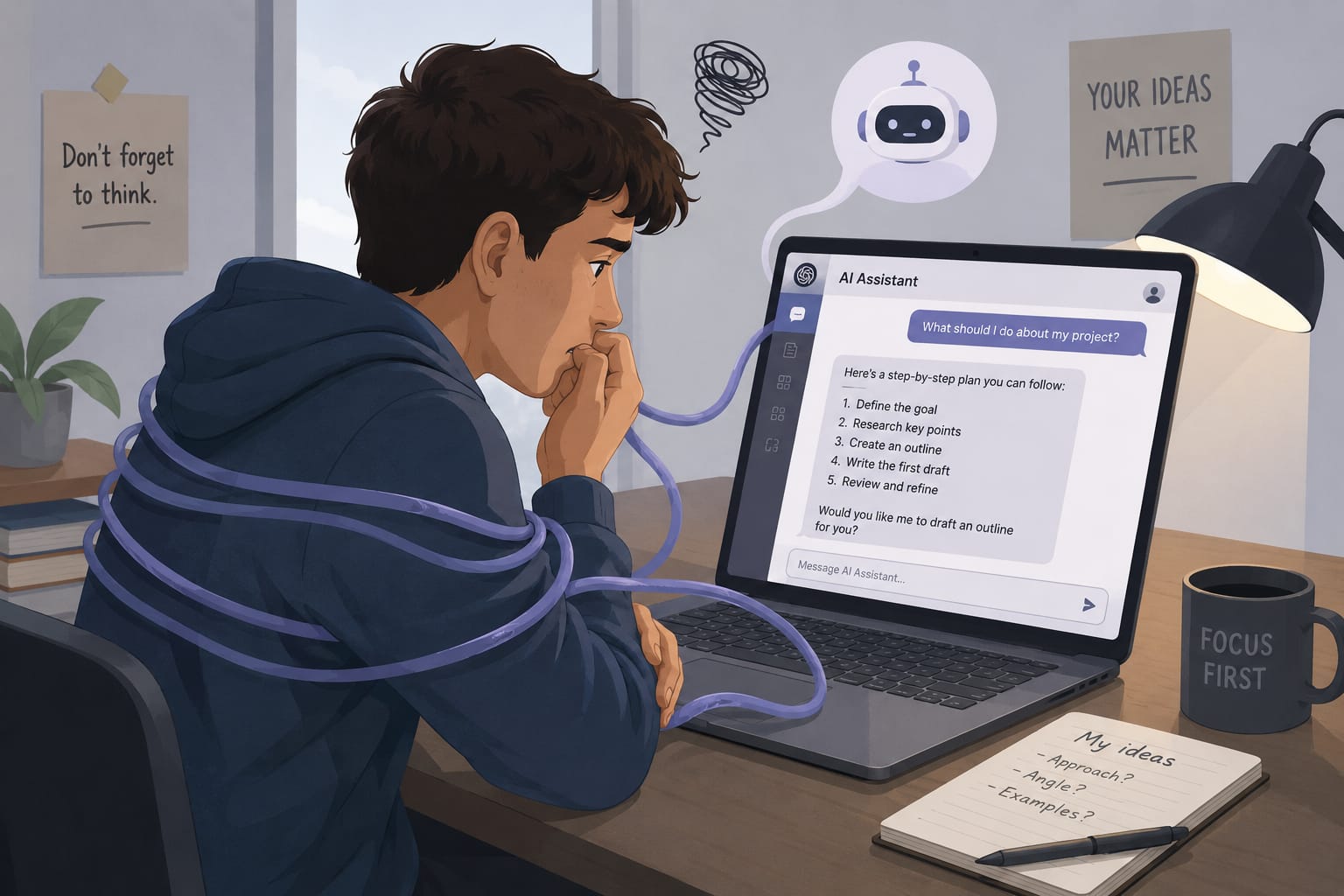
AI dependency risks are rising fast in 2026 — and most people don’t realize they’re already affected.
In 2023, AI tools were a novelty. In 2024, they became useful. By 2026, millions of people use them daily for writing, research, decision-making, and creative work. That’s a good thing — until it isn’t.
The problem isn’t AI. AI tools are genuinely powerful. The problem is what happens when “using AI” quietly becomes “unable to function without AI.” When the tool becomes a crutch. When the help becomes a dependency.
This article covers what AI dependency actually looks like, seven specific warning signs to watch for, and how to keep AI in its proper role — as a powerful assistant, not a replacement for your own thinking.
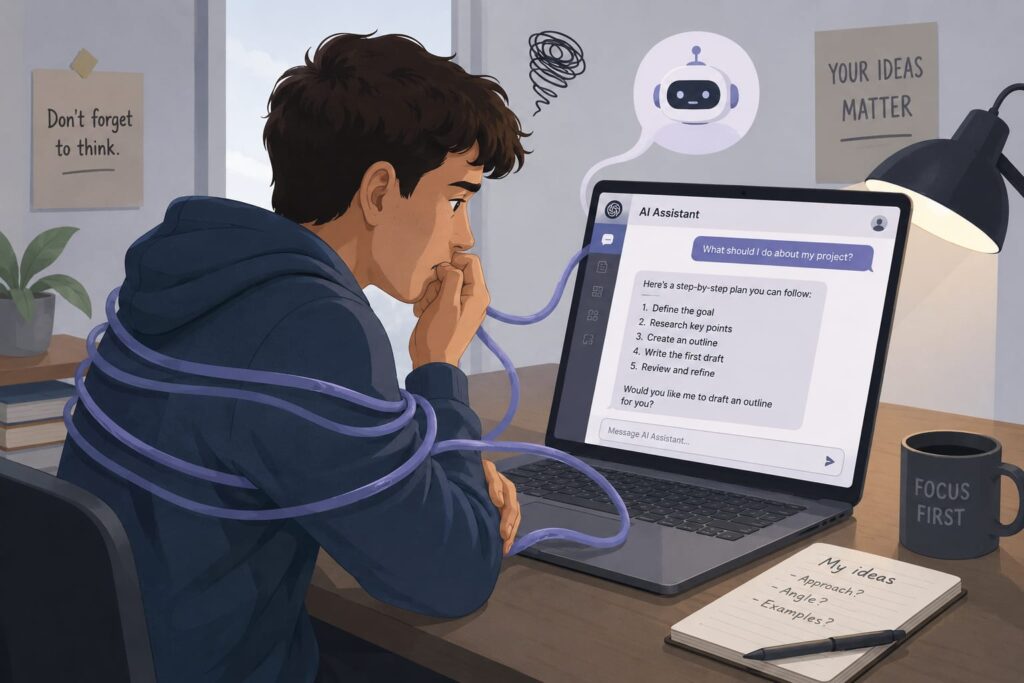
What Is AI Dependency?
AI dependency is a pattern of overreliance on AI tools — where a person’s ability to think, create, or work is significantly reduced when AI isn’t available.
It’s not about using AI frequently. Frequent use is fine. It’s about what happens to your capability without it.
How It Develops Gradually
Nobody wakes up one day and decides to become dependent on AI. It happens slowly, through a completely understandable process.
You use AI to help write an email — and it’s faster and better than your draft. You use it for research — and it saves you an hour. You use it for a presentation — and the output impresses your manager.
Every step feels like a win. And it is a win. But over time, without realizing it, you stop practicing the underlying skill. Writing feels harder when you try it alone. Research feels overwhelming without AI summaries. Thinking through problems independently takes more effort than it used to.
This is the boiling frog pattern. Each individual step is harmless. The cumulative effect is significant.
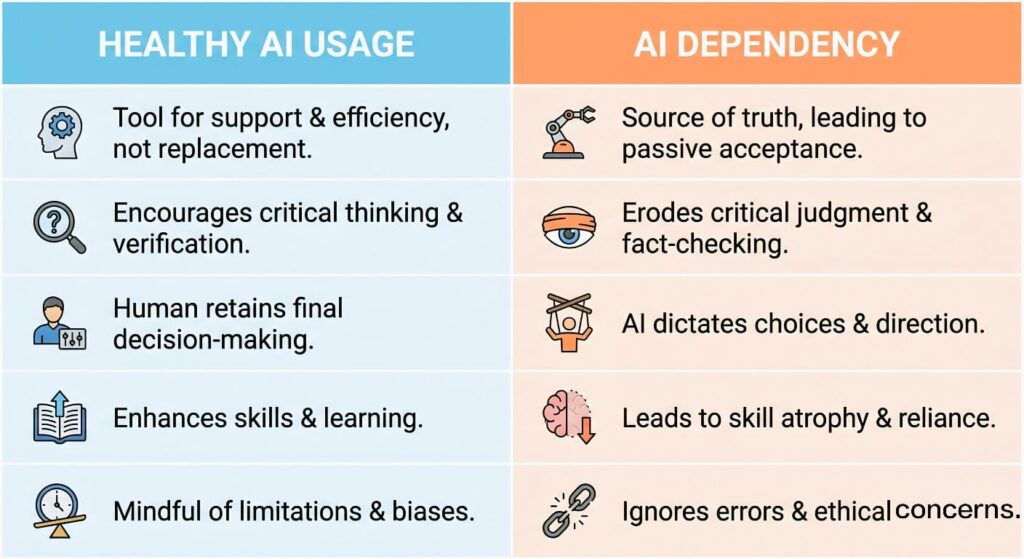
Healthy AI Usage vs Harmful Dependency
The line between the two is clearer than you might think:
Healthy AI usage:
- You use AI to speed up work you can already do
- You review and edit AI output with your own judgment
- You could do the task without AI — it would just take longer
- Your underlying skills are maintained or growing
Harmful dependency:
- You can’t start a task without AI involvement
- You publish or deliver AI output without fully understanding it
- You’ve lost confidence in your own ability to produce work
- Your skills feel weaker than they were before you started using AI
If any of the second list resonates, the rest of this article is for you.
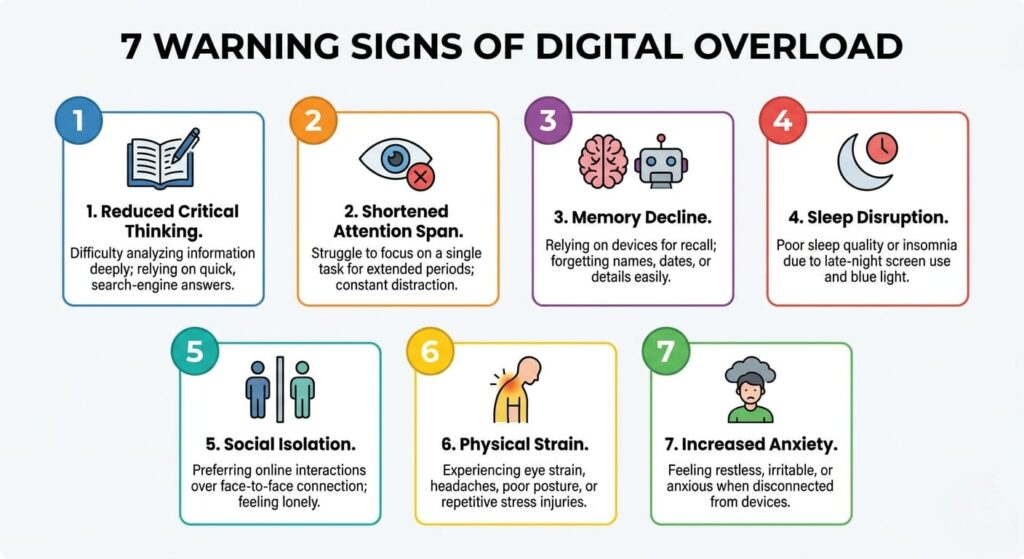
7 Warning Signs of AI Dependency & Risks
Go through each of these honestly. They’re not meant to create guilt — they’re meant to create awareness.
1. You Can’t Write a Paragraph Without AI
You open a blank document. You need to write something — an email, a summary, a quick response. And instead of writing, your first move is to open an AI chat and describe what you need.
Not because the task is complex. Because writing without AI now feels uncomfortable or slow.
This is a sign that a fundamental communication skill is atrophying. Writing — even imperfectly — is thinking. When you outsource that first draft to AI every time, you’re outsourcing part of your thinking process.
Why it matters: Writing ability is one of the most transferable professional skills. Letting it erode through consistent non-use has career consequences beyond just AI dependency.
2. You Publish Content Without Reading AI Output
You ask AI to write something. You quickly scan the first few lines. It looks fine. You hit publish.
This is one of the most common — and most dangerous — patterns in AI dependency. It means you’re not actually in control of what you’re putting out under your name.
AI output can contain factual errors, outdated information, logical inconsistencies, and tonal mismatches. All of which you’d catch if you read carefully. None of which AI catches on its own.
Why it matters: Your reputation is attached to your output. AI doesn’t share that reputation. You do.
3. You Trust AI More Than Your Own Knowledge
You know something from years of experience. AI says something different. You assume AI is right.
This happens more than most people admit. And in many cases, you’re wrong to defer — because you actually know more about your specific context, your clients, your industry nuances than any general-purpose AI does.
AI has broad knowledge and specific limitations. You have specific knowledge and lived experience. The combination is powerful. One replacing the other is a problem.
Why it matters: Your domain expertise is your professional value. Subordinating it to AI judgment systematically erodes what makes you valuable.
4. You’ve Stopped Learning New Skills
“Why bother learning X when AI can just do it?”
This reasoning sounds efficient. In practice, it creates a brittle skillset that’s entirely dependent on AI availability — and on AI remaining capable of doing X.
Skills compound over time. The person who learns consistently, even slowly, builds something AI can’t replicate: genuine understanding, transferable knowledge, and the ability to adapt when the tools change.
Why it matters: AI capabilities change rapidly. Skills you outsource completely become gaps when the tool changes, becomes unavailable, or gets something importantly wrong.
5. You Feel Anxious When AI Is Not Available
Internet is down. AI service is temporarily unavailable. Your account has a usage limit.
How do you feel? Mildly inconvenienced — or genuinely unable to proceed with your work?
If a tool’s temporary unavailability significantly disrupts your ability to function professionally, that tool has become a dependency rather than a resource.
Why it matters: Tools go down. Services change pricing. Platforms make decisions that affect your access. Building your entire workflow around any single tool — especially one you don’t control — creates unnecessary fragility.
6. You Can’t Explain What AI Wrote for You
Someone asks you about a piece of content, a report, or a proposal you submitted. And you realize — you can’t actually explain the reasoning behind it, because you didn’t reason through it yourself. AI did.
This is professionally and intellectually dangerous. Your name is on the work. You’re expected to understand and defend it. If you can’t, that’s a problem — regardless of how good the output looks.
Why it matters: In professional contexts, work you submit is work you own. That includes the reasoning, the claims, the recommendations. If you can’t explain it, you don’t actually own it.
7. Your Critical Thinking Has Noticeably Reduced
You used to analyze situations from multiple angles. You used to question assumptions. You used to think through problems before arriving at conclusions.
Now, increasingly, your first move is to ask AI what to think.
Critical thinking is like a muscle. It develops with use and weakens with disuse. If your daily thinking involves routinely outsourcing the analysis to AI, the muscle gets less exercise — and the effect is cumulative.
Why it matters: Critical thinking is the meta-skill behind everything else. It’s what lets you evaluate AI output intelligently, catch mistakes, and make good decisions. Its erosion affects every area of your professional life.
The Hidden Technical Problem — Context Window Fatigue
There’s a technical dimension to AI dependency that most users don’t understand — and it makes the problem worse.
Every AI conversation has a context window — a limit on how much information the AI can actively process at once. When you work in long, unbroken sessions, the context window fills up. The AI starts losing track of earlier parts of the conversation. Output quality drops. Inconsistencies appear. Hallucinations increase.
This means that the user who works in marathon AI sessions — pushing for more output, more iterations, more refinement without breaks — actually gets worse results than someone who works in focused sessions with breaks between them.
The practical implications:
- Break long sessions — close the conversation and start fresh when quality drops
- Recognize the signs — repetitive output, contradictions, vague answers are signals the context is overloaded
- Give buffer time — a fresh session isn’t just a reset for the AI, it’s a reset for your own thinking
AI is a capable helper. But a capable helper also needs reasonable working conditions to perform well. Push too hard, for too long, without breaks — and you get diminishing returns from both the AI and yourself.
How to Use AI as a Multiplier — Not a Crutch
This is the mental model shift that changes everything.
The Core Principle
AI is a capable helper. The work — the thinking, the judgment, the direction — is yours.
Think of it this way: if you hired a brilliant research assistant, you wouldn’t hand them a vague brief and publish whatever they returned without reading it. You’d give them clear direction, review their work, apply your judgment, and take responsibility for the final output.
Microsoft’s framework on overreliance on AI outlines similar patterns — and recommends keeping humans meaningfully in the loop for high-stakes decisions.
That’s exactly how AI works best.
The Multiplier Formula
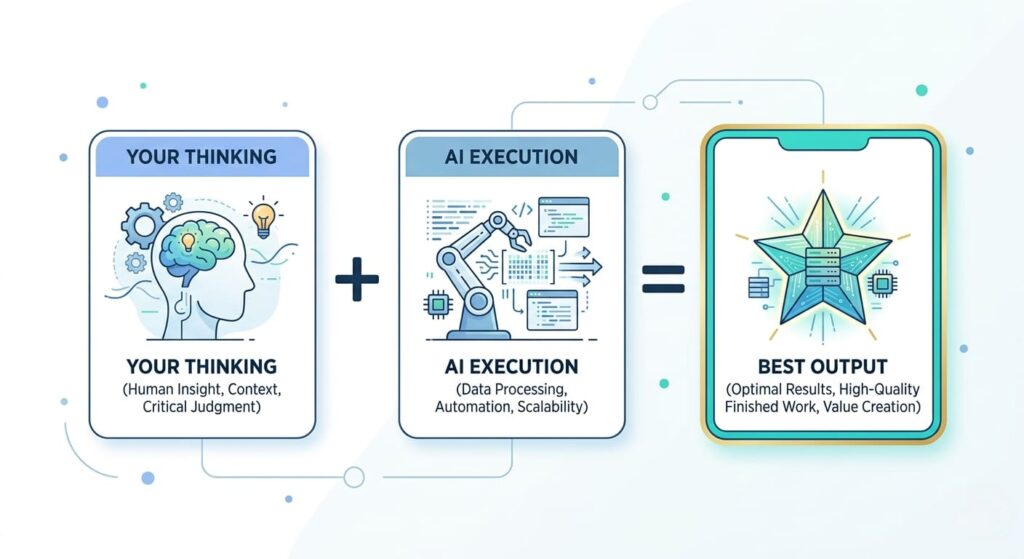
Your thinking + AI execution = best output
Not: AI thinking + your publishing = what most people do
The difference is enormous. In the first model, you supply the judgment and AI supplies the speed. In the second, nobody is actually responsible for the quality — which is why so much AI-assisted content is generic, shallow, and forgettable.
Skills That Must Stay Yours
Regardless of how much you use AI, certain capabilities need to remain your own:
- Core reasoning — thinking through problems without AI involvement
- Domain judgment — applying your actual expertise and experience
- Output ownership — understanding and being able to explain everything you publish or deliver
- Critical evaluation — reading AI output as a skeptical editor, not an approving publisher
These aren’t optional. They’re what makes you a professional rather than someone who operates an AI tool.
The Right Balance — Working With AI, Not Depending On It
Why Base Knowledge Still Matters
You can’t effectively direct an AI assistant in a field you don’t understand. You can’t catch its mistakes if you have no independent knowledge to check against. You can’t ask the right questions if you don’t know enough to know what’s missing.
This is why continuous learning matters even in an AI-abundant world. Not to compete with AI — but to be able to use AI well. Base knowledge is what turns AI from a liability (you don’t know what’s wrong) into an asset (you can guide it toward what’s right).
How to Maintain Critical Thinking
Critical thinking doesn’t disappear overnight. It diminishes through habitual shortcuts. The way to maintain it:
- Think before prompting — spend two minutes on your own before asking AI anything
- Challenge AI output — treat responses as a starting point, not a conclusion
- Write regularly without AI — even if just for notes or journaling
- Explain your work — make a habit of being able to summarize and justify what you submit
Trial and Error Is Your Real University
The people who get the most from AI aren’t the ones with the most technical knowledge. They’re the ones who experiment the most.
They try things. They notice what works and what doesn’t. They develop intuition through experience. That intuition — built through personal trial and error — is genuinely yours. It compounds over time. It can’t be outsourced.
Action Steps to Break AI Dependency
If any of the seven warning signs resonated, here’s a practical path forward.
1. Practice daily “no AI” writing
Write for ten minutes every day without AI involvement. Emails, notes, ideas — anything. The goal is to keep the muscle active.
2. Always verify before publishing
Make it a rule: if AI wrote it or significantly contributed to it, you read every word before it goes out. Not skim — read.
3. Weekly skill-building without AI
Pick one skill per week to practice without AI assistance. The task will feel slower. That’s the point.
4. Use AI tools more deliberately
Our free AI Prompt Builder helps you build better prompts — which means you’re putting more of your own thinking into the process upfront, not just hoping AI figures out what you need.
5. Regular self-audit
Monthly, ask yourself: could I do my job if AI tools were unavailable for a week? If the honest answer is “barely” or “no” — that’s your signal to recalibrate.
Conclusion
AI tools are genuinely powerful. Used well, they multiply your output, speed up your work, and help you produce things you couldn’t produce alone.
But the key phrase is “used well.”
AI dependency — the pattern of overreliance where your own capabilities diminish — is a real risk in 2026. It doesn’t announce itself. It develops gradually, through habits that each feel like efficiency gains.
The seven warning signs in this article are checkpoints, not judgments. If you recognize yourself in them, that’s useful information — not a reason to stop using AI, but a reason to use it more deliberately.
The best version of human-AI collaboration is one where AI makes you more effective, not one where AI makes you dependent. That version requires you to stay in the driver’s seat — thinking clearly, maintaining your skills, and owning your output.
AI is the assistant. You’re the professional. Keep it that way.
And if you want to explore more about using AI effectively, check out our article on how AI actually affects your job — and start building your AI workflow the right way.
FAQ
What are the main AI dependency risks?
The main risks include erosion of critical thinking, skill atrophy, publishing unreviewed AI output, and building workflows so dependent on AI that normal functioning is disrupted when tools are unavailable.
How do I know if I’m too dependent on AI?
Key signs include inability to write without AI, publishing without reviewing output, trusting AI over your own knowledge, and feeling anxious when AI tools are unavailable.
Is using AI every day bad?
No — frequency of use isn’t the problem. The problem is whether your own capabilities are maintained alongside AI use. Daily AI use is fine when you’re still thinking, reviewing, and maintaining your skills independently.
How can I reduce my AI dependency?
Practice writing and problem-solving without AI regularly, always review AI output before using it, maintain weekly skill-building without AI assistance, and use AI as an execution assistant — not a thinking replacement.
What is the context window problem in AI?
Every AI conversation has a limit on how much it can process at once. Long, unbroken sessions cause quality to drop and hallucinations to increase. Working in focused sessions with breaks produces better results.
Can AI dependency affect my career?
Yes. Over-reliance on AI can erode skills, reduce your ability to explain and defend your work, and create fragility if AI tools change, become unavailable, or make important mistakes you’re not equipped to catch.